

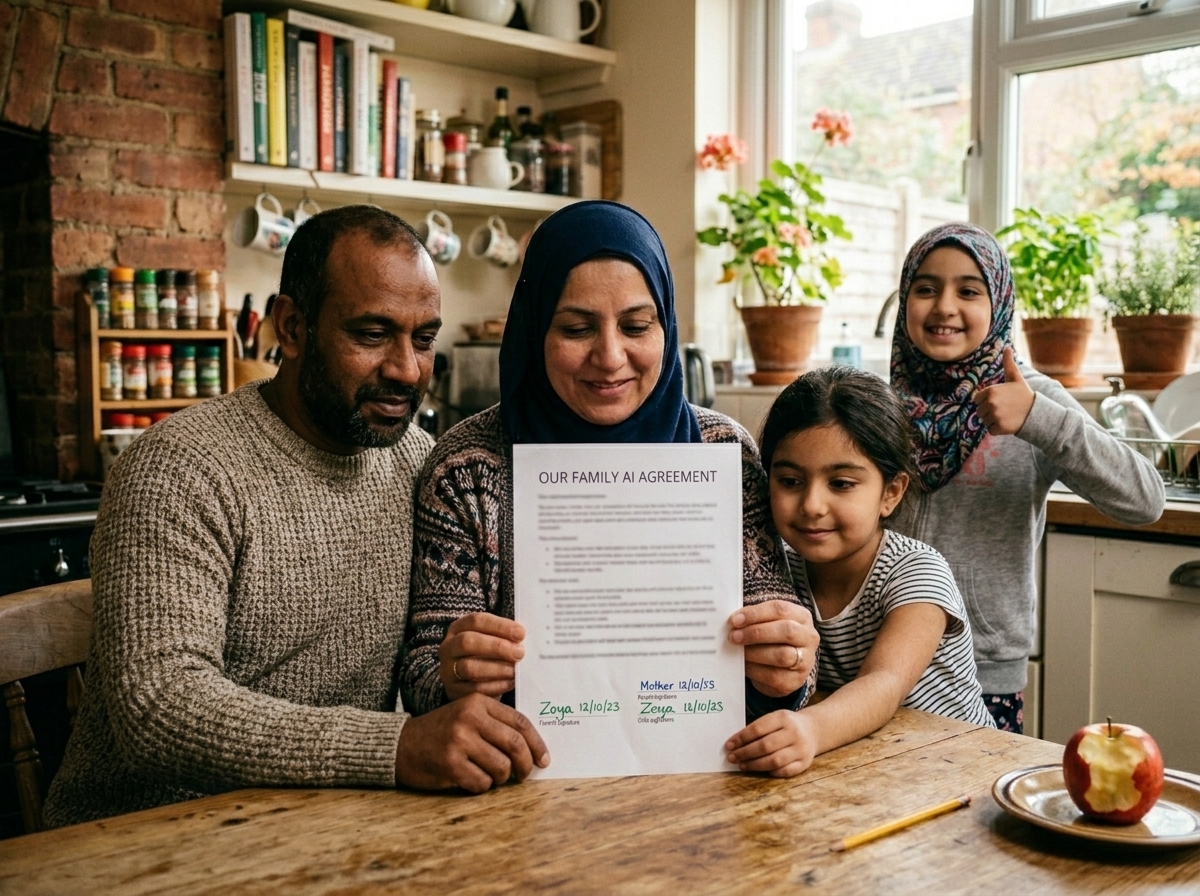
The argument plays out in plenty of all households including the homeschool. A parent finds out their kid has been using ChatGPT for homework. The parent had not anticipated needing rules. The kid had not anticipated needing permission. The argument is not really about AI. It is about what counts as their own work and what does not. Neither side has ever said it out loud.
If you have not had that conversation yet, you will. Here is how to have it once, write it down, and not have it again every week. This post includes a one-page family agreement you can print, fill in, and sign together in fifteen minutes.
The five rules below are the framework we use with the families in our cohorts. They work because they are short, specific, and signed.
The data parents underestimate
The Common Sense Media report The Dawn of the AI Era surveyed teens and parents in 2024. Seventy percent of teens had used generative AI. Only 37 percent of parents whose teen reported using AI knew their kid was using it. Half of parents had never spoken with their child about AI.
Independent confirmation from Pew Research found that the share of teens using ChatGPT for schoolwork doubled between 2023 and 2024, from 13 percent to 26 percent. Among 11th and 12th graders the number is 31 percent. Among Black and Hispanic teens it is 31 percent. The trend is steep and the awareness gap inside the home is wide.
UNICEF has been blunt about the implication. Their parenting in the AI age guide recommends that families set explicit norms together rather than rely on rules from teachers or platforms. The reason is straightforward. The kids who internalize their own household's rules behave more consistently than the kids who only follow rules imposed from outside.
A written agreement is therefore not pedantry. It is the small ritual that gives your family a shared vocabulary and saves you the same argument fifty times.
Why a written rule beats a verbal one
A verbal rule degrades in two weeks. A signed rule on the fridge survives months. The signing ritual matters more than the wording. Sit down together. Read each line out loud. Sign in two different colored pens. Stick it where everyone sees it. Revisit it quarterly.
Adults forget how seriously kids take this. We have watched eleven-year-olds quote their family agreement to a fifteen-year-old sibling. The agreement creates social proof inside the home. That is its quiet power.
The five rules that actually work
These are the rules we recommend. They are short on purpose. The shorter the rule, the more often it gets followed.
Rule 1: We say where AI helped
If you used AI to write, draw, calculate, or research, you say so when you share the result. Not as confession. As habit. Parents do this too. The kid sees the parent saying "I used Claude to help draft this email" and the asymmetry disappears.
This rule does two things at once. It builds the habit of attribution, which is the foundation of academic honesty later. And it surfaces AI use without making it secret, which is what fuels the Common Sense Media awareness gap.
Rule 2: We fact-check anything that matters
AI is wrong often enough that "anything that matters" is a real category. The rule is one sentence: if a wrong answer would embarrass you, harm someone, or get you a bad grade, you check it against a second source. That source can be a textbook, a teacher, a parent, a different AI, or a Google search to a real publisher.
We teach a small game called Catch the Lie. Ask the AI a factual question you know the answer to. Look for the wrong detail it sneaks in. Identify the source of error. Run the game once a week. Kids who play it for a month develop a permanent suspicion of confident-sounding wrong answers.
Rule 3: We don't paste private information
A short list of things never to paste into a chatbot. Home address. Phone number. Family member's full names with school. Photos. Anything that would be in a school disciplinary record. Anything from a private conversation. Financial information.
This is the rule kids most often roll their eyes at and most often need. Worth its weight.
Rule 4: We build with AI; we don't just consume
This is the rule that makes our homeschool families different from the rest. AI is most useful when you are making something. Use it to help write a story, design a poster, build a Scratch game, draft a tutoring script, plan a birthday party. The goal is to make AI a creative tool, not an entertainment feed.
The test for any kid: can you point to one thing you made this week where AI helped? If not, the AI time has tilted toward passive consumption. Adjust.
Rule 5: We talk about it weekly
A fifteen-minute family conversation, every Sunday or every Friday, about what each person used AI for that week. No grading. No punishment. Just sharing. The conversation does the work. Kids who talk weekly are less likely to develop the over-reliance Pew documented.
Make it a meal. Make it a walk. Make it short. Make it consistent.
The signing ritual (15 minutes)
Pick a Saturday morning. Bring out two pens of different colors. Sit at the kitchen table. Read each rule aloud. Discuss any wording that needs adjusting. Sign at the bottom, both parents and each child. Photograph it. Send the photo to grandparents if they help with childcare.
Stick the printed copy on the fridge. Move it to a clipboard if siblings start ignoring it. Revisit it on a fixed quarterly date. Update if needed.
This ritual sounds excessive. It is the single highest-leverage thing a parent can do in 2026 for AI literacy at home. Cheaper than any subscription. More effective than any lecture.
When to revisit
Every three months on a fixed date. Plus any time a rule got broken in a way that mattered. The conversation when a rule breaks is the conversation that teaches the most. Approach it as an update to the agreement rather than a punishment cycle. The agreement is a living document. The kid sees that real adults treat written agreements that way.
What the rules give your family
A shared vocabulary. A way to talk about AI without it becoming a fight. A foundation for the harder conversations that come later: AI companion apps for lonely teens, AI-generated images that look real, classmates using AI in ways your kid will be tempted to copy.
We have watched families in our cohorts come back to us after six months and say the AI agreement quietly became the most useful thing they did all year. It cost nothing. It took fifteen minutes. It changed the temperature in the home.
If your family is already comfortable with the rule-setting, the next step is to put AI in their hands as a creative tool, not just a homework helper. The Summer Coding Bootcamp does exactly that. Two age-tailored tracks, six weeks, AI baked into the curriculum at age-appropriate depth. Sibling discounts make multi-child homeschool families particularly welcome.
If you want a deeper look at our approach to keeping young learners safe across the broader stack, the child safety page lays out our practices in detail.
Sign the agreement first. The rest gets easier afterwards.
Sources