
Creative Minds.Digital Citizens.
- Scholar's Journey
- Productive Engagement
- and more
Coding is the 4th literacy. In live small-group cohorts, learners build real games, apps, and AI products with named mentors: then demo them on Demo Day.Flexible scheduling for homeschooling families, parent-visible progress, and a clear ladder from first block of code to a launched product.
30-minute Zoom · no card needed · a custom learning plan you keep
Built Around the Homeschool Rhythm
Homeschooling families are at the heart of what we do. Every cohort runs as live, instructor-led virtual classes, so your child learns alongside peers across continents without leaving your schedule behind.
From Block Coding to AI Engineering
Web · Mobile · Desktop · AI. Real tools, taught well: for every age and every level.
Block & Visual Coding


Web Design & Web Apps
Desktop & Intelligent Systems
Programming Languages
Mobile Apps (Android & iOS)


AI · ML · LLMs · Prompt Engineering
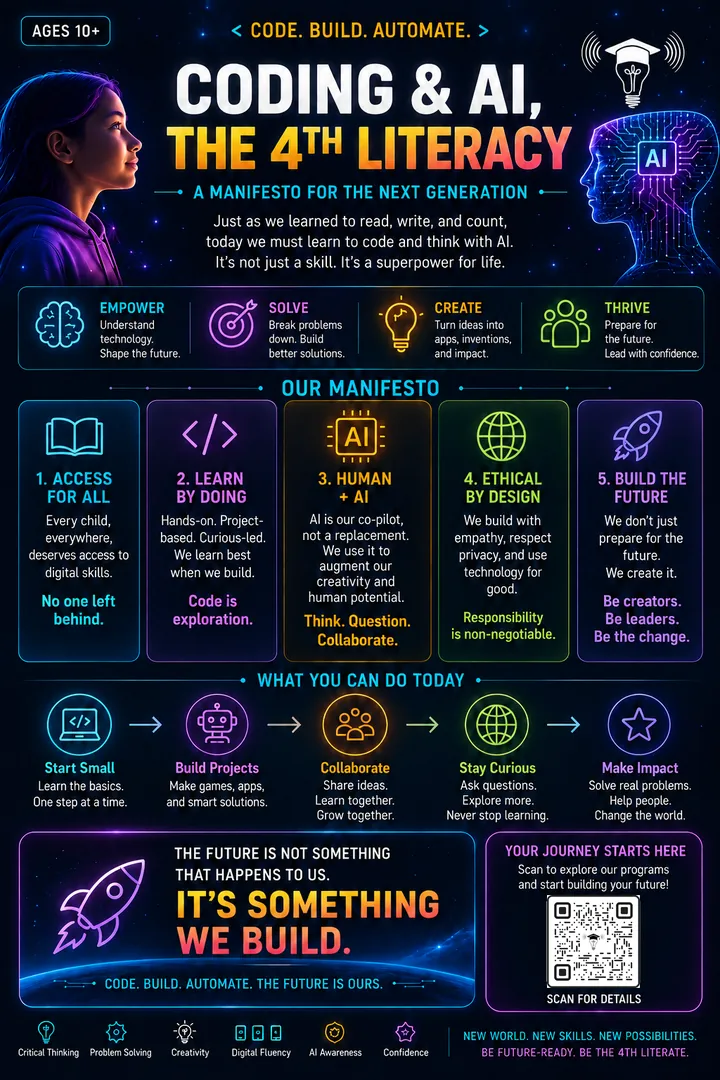
Coding & AI: the 4th Literacy
Reading, writing, and arithmetic shaped the last century. Coding and AI are the foundational skills shaping this one: the language of technology, creativity, and solving problems that matter.
Reading
Understanding language to make sense of the world and absorb knowledge.
Writing
Creating and communicating ideas that shape thought and inspire action.
Arithmetic
Numbers, logic, and reasoning: the foundation of analytical thinking.
Coding & AI
The language for navigating and shaping the digital world: coding and AI foster creativity, logic, critical thinking, and real-world problem-solving.
Skills That Last Beyond the Screen
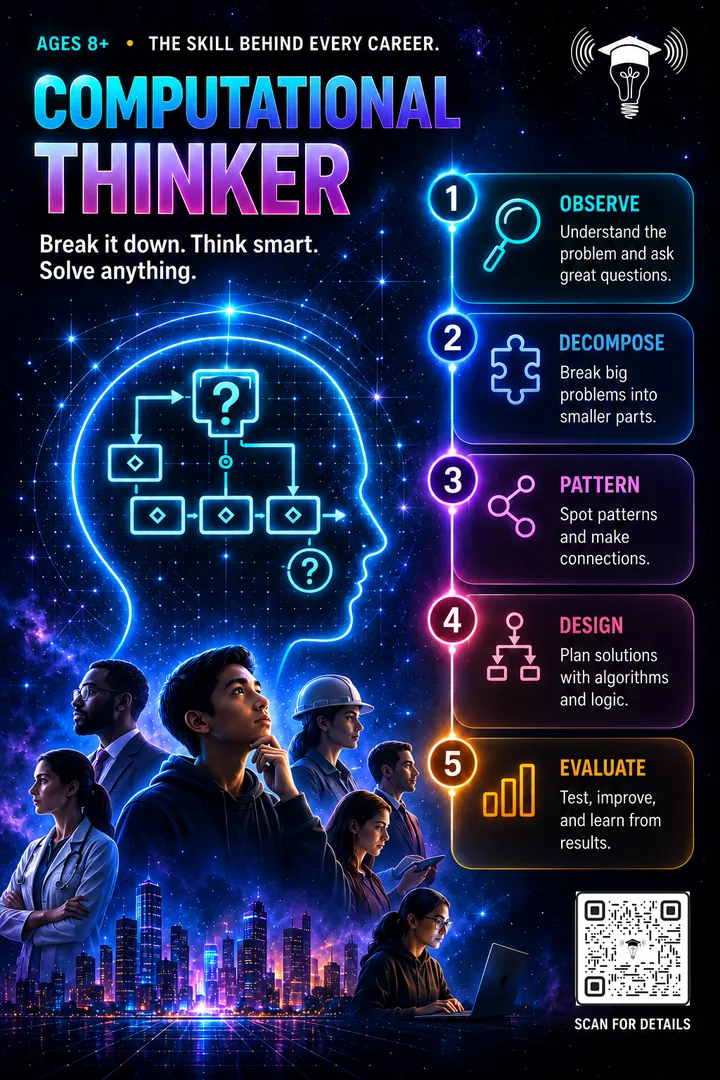
Alongside coding and AI, every ScholarlyEcho program builds computational thinking, problem solving, digital citizenship, and online safety. These are the habits that help learners think clearly, work through hard problems, and stay safe and responsible online.
Computational thinking
Breaking a big problem into small steps, spotting patterns, and designing a clear sequence of instructions. It is the thinking behind every program, and it carries straight into math, science, and everyday decisions.
- Decomposition
- Pattern recognition
- Abstraction
- Designing algorithms
Problem solving
Every project has bugs. Learners practise testing an idea, finding what went wrong, and trying again, which builds persistence and the confidence to tackle problems that have no single right answer.
- Debugging
- Testing ideas
- Persistence
- Creative solutions
Digital citizenship
Using technology and AI responsibly, respectfully, and honestly: crediting other people’s work, using AI tools with integrity, communicating kindly online, and understanding how apps collect and use data.
- Responsible AI use
- Respectful communication
- Crediting sources
- Understanding data
Online safety
Protecting personal information, creating strong passwords, recognising scams, phishing, and suspicious links, and knowing when to step away and ask a trusted adult for help.
- Protecting privacy
- Strong passwords
- Spotting scams and phishing
- Asking for help
Technical Skill Is One Third of the Job
Teaching a young person to code is the part everyone can see. Showing them where the skill leads, and keeping them engaged long enough to get there, is the rest of it. ScholarlyEcho is built to do all three.
Built for Results
Coding for Kids
Fun, visual coding using Scratch and beginner Python. Builds logic, creativity, and confidence.
AI Foundations Track
Machine learning, prompt engineering, Python AI. Prepare for the AI-first economy.
Product Builder
Build and launch real SaaS products. Startup thinking, MVP development, and pitch coaching.
Code Prodigy Elite
Elite cohort for exceptional learners: hackathons, industry mentors, real project showcases.
Our Programs
Past and upcoming programs that shape the next generation of builders.
Programs
Upcoming
Questions Parents Ask Before Enrolling
Straight answers on ages, cost, format, and what your child walks away with. See every answer.
Who are ScholarlyEcho classes for?
ScholarlyEcho teaches coding and AI to kids, teens, and adults, from age 5 with no upper age limit. Kids start with visual block coding in Scratch and move on to Python and app building, teens progress into web development and AI engineering, and adults learn Python, web development, and AI through one-on-one tutoring or a product-building cohort. Placement is by ability rather than age.
Do learners need any coding experience to start?
No experience is required. Every learner begins with a free 30-minute assessment class that establishes their current level, and they are then placed at the matching rung of the Coders Ladder, which runs from complete beginner through to AI and product engineering.
How much do ScholarlyEcho classes cost?
Plans start at $110 per month for one session per week, $200 per month for two sessions per week, and $350 per month for one-on-one instruction. Families enrolling more than one child receive 10 percent off the second child and 15 percent off the third, and need-based scholarships are available each cohort.
Are the classes live or pre-recorded?
All ScholarlyEcho classes are live and led by an instructor in small cohorts. Learners can ask questions in the moment, receive direct feedback on the project they are building, and work alongside peers rather than watching recordings alone.
Does ScholarlyEcho work for homeschooling families?
Yes. Homeschooling families are a core audience. ScholarlyEcho offers weekday, weekend, morning, and evening slots so classes fit an existing homeschool timetable, gives parents visible progress tracking with mentor notes, and allows parents to observe sessions for learners under 13.
What does a learner actually produce by the end?
Every learner finishes with work they can show. Depending on the track, that means a playable game, a working mobile or web app, or a deployed AI product with a live URL. Each cohort ends with a Demo Day where learners present what they built, and completed projects form a portfolio suitable for scholarship and university applications.
How are ScholarlyEcho instructors vetted?
Instructors are background-checked before they teach and are selected for professional experience in the subject they deliver. Cohorts are kept small so each learner receives direct attention, and parents of learners under 13 may observe sessions.
Where does ScholarlyEcho operate?
ScholarlyEcho is based in Maryland and teaches entirely online, so learners join live classes over Zoom from anywhere in the United States, with slots for Eastern through Pacific time. Learners also join from the United Kingdom, Nigeria, Ghana, and Kenya.
Why does ScholarlyEcho pair coding classes with mentorship?
Technical skill determines whether a young person is capable, but guidance determines whether that capability is recognised. Learners without professional networks often cannot see which projects matter, when to apply, or how a first role is won. ScholarlyEcho pairs every technical track with people already working in the field so learners get both the skill and the direction.
Does ScholarlyEcho teach more than coding?
Yes. Alongside coding and AI, every ScholarlyEcho program builds four lasting skills: computational thinking (breaking problems into steps and designing algorithms), problem solving (debugging, testing ideas, and persisting), digital citizenship (using technology and AI responsibly and respectfully), and online safety (protecting personal information and recognising scams and phishing).
Does ScholarlyEcho teach online safety and digital citizenship?
Yes. Online safety and digital citizenship are built into ScholarlyEcho classes rather than taught as a one-off lesson. Learners practise protecting personal information, creating strong passwords, spotting scams, phishing, and suspicious links, using AI tools honestly, crediting other people’s work, and communicating respectfully online.
How does learning to code improve problem-solving skills?
Coding trains computational thinking and problem solving directly. To make a program work, a learner must break a goal into small steps, spot patterns, and write precise instructions, then test the result, find what went wrong, and fix it. Repeating that cycle on real projects builds logical reasoning and persistence that carry into math, science, and schoolwork.
Still deciding? Ask us directly.
Talk to the team
The future belongs to builders.
Be one.
Join 200+ young people already building skills, making impact, and writing their own story: with ScholarlyEcho.