

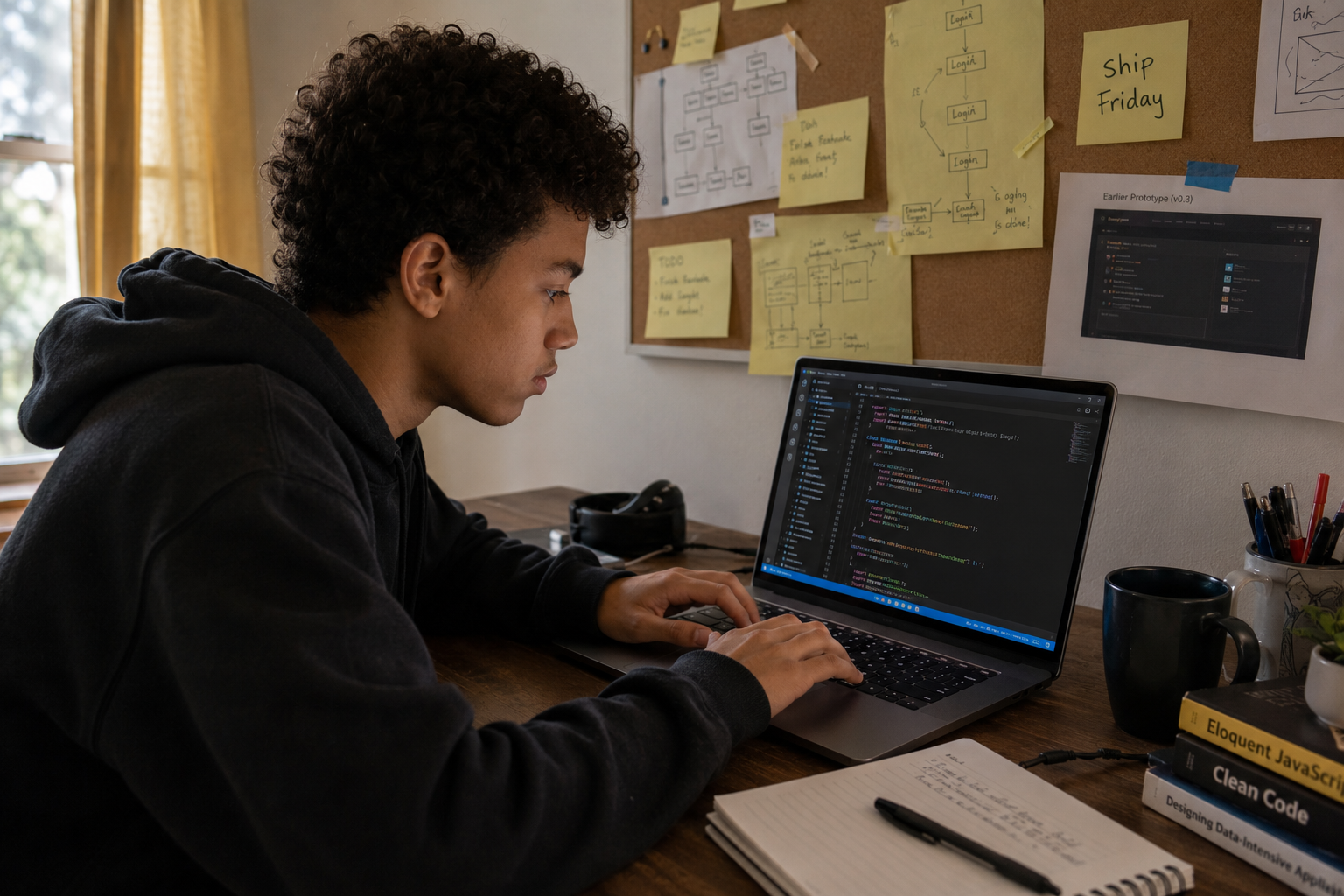
Parents ask us a version of this question every week. The wording differs. The fear is the same. If AI writes code now, am I about to spend years and a small fortune teaching my kid a dying skill?
Here is the short answer. Coding is more valuable to learn in 2026 than it was in 2020, but the actual job has changed under your feet. The students winning today are not the ones grinding LeetCode in a closet. They are the ones who can read code, debug it calmly, direct AI to write the parts they cannot, and ship something a real person uses by the end of the month. If you measure "coding" the old way, the curve is brutal. If you measure it the new way, the opportunity is wider than it has ever been.
I run a course called Idea2MVP. Our students are eleven to twenty-two. Some come in having never seen a line of code. Ten weeks later they walk out of Demo Day with a live URL, five real users, and a metrics dashboard. That is not magic. It is what becomes possible the moment you stop teaching the 2018 curriculum and start teaching what the work actually looks like now.
The numbers behind the panic
You did not imagine the headlines. According to the World Economic Forum's Future of Jobs Report 2025, 22 percent of jobs in the formal labor market will see structural change by 2030. The report projects 170 million new roles created and 92 million displaced. AI and big data sit at the very top of the skills employers say they need to grow most aggressively.
Harvard Business Review's March 2026 piece on entry-level work made the squeeze concrete. Employment of US software developers aged 22 to 25 dropped nearly 20 percent from its late-2022 peak. The IDC/Deel global enterprise survey HBR cited found 66 percent of large employers plan to reduce entry-level hiring as AI takes over routine work.
That is the number that scared parents into my inbox. It deserves to be taken seriously. But it is not the whole picture. The same HBR report notes that companies like IBM are tripling entry-level hiring and shifting the criteria toward adaptability, AI fluency, and real-world judgment. McKinsey forecast a 12 percent increase in junior hires in North America for 2026. The jobs are not vanishing. The job description is being rewritten in real time.
Which brings us to the more useful question. Not "is coding worth it." But "what is the job in 2026, and how does my kid become the person who gets it."
What the work actually looks like now
The 2024 Stack Overflow Developer Survey gave us the clearest picture I have seen of how working developers spend their day. Seventy-six percent of respondents use or plan to use AI tools in their workflow. Eighty-two percent of those using AI use it to write code. Sixty-eight percent use it to look up answers.
Here is the line nobody quotes from the survey: only 43 percent trust the accuracy of AI tools, and 45 percent believe AI tools struggle on complex tasks. So the work has already become two things at once. AI writes the first draft. The human reads it, catches the errors, redirects it, ships it. The economic value is moving toward the second half.
That is a totally different job from the one your CS-major older cousin trained for in 2017. It needs a different curriculum. Most schools have not caught up. That gap is your kid's opportunity.
The wrong reason to learn coding
The wrong reason in 2026 is "to get a stable tech job." That framing made sense ten years ago. It is fragile now. The pipeline of "learn Python, pass interviews, get a salary" is being squeezed on both ends. Automated screening filters out the resumes. Automated code completion compresses the work. The middle of that funnel is the part shrinking.
I have watched bright students get caught in this trap. They spend nine months on algorithm puzzles. They never ship anything anyone uses. They show up to admissions interviews or first-round hiring screens with a clean GitHub of LeetCode solutions and zero products with users. In 2026 that is a hard sell. The bar for "shows initiative" has moved.
The right reason
The right reason is "to be the kind of person who turns an idea into a working thing." That skill compounded as AI got better, not the other way around. AI made it cheaper to build, which moved the bottleneck to taste, problem selection, and follow-through. Those are human skills.
People who win at this level do four things well.
First, they find a problem worth solving by talking to real humans rather than assuming. Second, they scope a small first version. Three core actions, not thirty features. Third, they direct AI to build it. They read enough code to know when the model lies. They debug calmly. Fourth, they get it in front of real users, learn from the wreckage, and ship a better version next week.
A fourteen-year-old who can do all four of those is more valuable in the 2026 labor market than a twenty-two-year-old who can recite Big O notation but never shipped anything. I know that sounds aggressive. It matches what I see employers reach for. The WEF report names the top growing skills as AI and big data, technological literacy, creative thinking, resilience, and curiosity. Not "memorizes textbooks."
What "learning to code" actually means now
The phrase has shifted meaning. Here is the honest 2026 definition.
Learning to code now means learning to read, debug, and direct.
Read is the new fluency. When Lovable or Bolt.new generates four hundred lines of React, you should be able to skim them and locate which file controls what. You do not need to write it from scratch. You need to know when it is wrong.
Debug is the new calm. AI will hallucinate API calls, misuse libraries, leak state. A good builder has a steady method for asking "where did this go off the rails," not a panic spiral. This is teachable. It used to take a year. It now takes two focused sessions.
Direct is the new craft. The most valuable single skill in the entire stack right now is writing the prompt that makes the model do useful work. Five-part prompts. Few-shot examples. Structured JSON outputs you can render straight into a UI. We dedicate a full module of Idea2MVP to this because students who can prompt well move ten times faster than students who cannot.
Notice what fell off the list. Memorizing every method on the Array prototype. Hand-rolling sort algorithms. Knowing the entire C++ spec. Those are not useless. They are not where the leverage is.
How to tell if a kid is building skill versus cargo-culting AI
This is the question every thoughtful parent asks at the free assessment class. Here is the test we use. It works at any age.
A kid who is actually building skill can do four things.
They can explain in plain language what their app does and who it is for. They can point to a screen and tell you "this part the AI wrote, this part I changed, this part is broken and I know why." They can describe one thing they tried that failed and what they did next. And they can show you one real person, not a parent, who has used the app and tell you what that person actually said.
A kid who is cargo-culting cannot do those things. They have a "project" but cannot describe how it works. They never run into walls because they never push past the demo. They cannot name the user.
The fix is not to take AI away. The fix is to require a user. Make them ship to one real person who is not a parent. That single rule changes everything in two weeks.
A simple 12-month plan by age
This is the framework we hand families when they ask "what should we be doing for our kid this year."
Ages 5 to 10
Spend the year in Scratch. Build small games. Build animated stories. Do not push text-based code yet. The cognitive jump from blocks to typing matters and lands better closer to 10 or 11. The goal at this age is not to ship anything to the public. The goal is to plant the mental model "I can make the screen do things." When the child can build a Scratch game with variables, broadcast messages, and custom logic on their own, they are ready for the next step.
Ages 11 to 14
Move to MIT App Inventor. The first time a kid runs their own app on a real phone is a milestone you cannot fake. Then introduce Python in small bites. Then start using AI as a thinking partner, not a homework crutch.
This is also the age to introduce the idea of shipping. Have them push a small thing to one classmate. Watch the change. The feedback from a real user is more motivating than any tutorial.
Ages 15 to 18
Idea2MVP territory. The skill stack: prompt engineering, AI app builders, lightweight code reading, picking real problems, talking to real users, shipping to a live URL by week five. Pair that with a tightly scoped GitHub presence and a Loom demo of the working product.
A teenager in this band who finishes a ten-week build with five real users on a live URL is in the top percentile globally. That is not a marketing line. It is what gets students through hackathons, scholarship pipelines, and the new style of admissions interviews where someone asks "what have you actually built."
What this means strategically for your kid this year
If you remember nothing else from this post, remember three things.
One, the safest investment in 2026 is not "learn to code." It is "learn to ship." Tools come and go. Shipped projects compound on a resume forever.
Two, your kid does not have to choose between depth and AI fluency. They should aim for both. Read enough code to direct AI well. Direct AI well enough to ship before the rest of the room finishes their slide deck.
Three, the strongest signal a 14- to 22-year-old can send right now is a live URL, a real user count, and a one-paragraph description of what they learned. That signal beats a 4.0 GPA in conversations I have had with university admissions offices and hiring managers in the last twelve months. Not always. Often enough that the strategy is clear.
Frequently asked questions
Will AI replace programmers? AI is replacing the boring parts of programming. It is not replacing the people who can turn an ambiguous business problem into a working product with users. That work is more in demand, not less.
Is computer science a dying degree? Not dying. Crowded. A CS degree without shipped products is worth less than it was. A CS degree with a portfolio of three live apps and one open-source contribution is worth more.
Should my kid still learn Python? Yes. It is the working language of AI tooling, data work, and most automation. Even when the AI writes the Python, your kid needs to read it.
Is it too late to start at 14? No. We have seen students start at 14 and ship a real product by 16. The bottleneck is not years on the keyboard. It is whether they finish.
What if my child does not want to be a software engineer? Even better. The students who use coding to solve a problem in another field, debate, music, sports, journalism, climate, are doing the same work founders do at 30. They are also the ones who stand out.
So is it worth it?
Yes, with one caveat. It is worth it if the goal is to build, ship, and learn from real users. It is not worth it if the goal is to grind syntax and hope the labor market of 2018 comes back.
If your child is between 11 and 22 and they want to learn to build real things with AI rather than wait for permission, Idea2MVP is the course we built for exactly that. Ten weeks, free-tier tools end to end, a live URL by week five, a public demo day at the end.
If they are younger than 11, the Summer Coding Bootcamp is the natural starting point. Two tracks, six weeks, a real app or game they made themselves.
The free assessment class is genuinely free. It is a 1:1 evaluation that tells you exactly where your child is and what they should do next. Most families find it useful even if they decide not to enroll.
The world your kid is going to work in is not the one we grew up in. The entry barrier for the right kind of work has never been lower. The wrong kind of work is shrinking fast. Aim them at the right one.
Sources